






E-commerce website redesign

Is your Shopify theme the same as the store next door's? Do your product pages describe, but never handle a single objection? Does the cart fill up, then empty at the shipping fees, and nobody knows what it costs you?
Good news: redesigning an online store is about the buying journey before it's about a theme.
A team that redesigned the stores of Pômesse, Moodz and Alpagga, and that opens your Shopify data before opening Figma.Product pages built around the three questions that block a purchase, then tested on your real traffic every 48 to 72 hours.A storefront developed by Dafolle, on Framer Commerce or as a custom Shopify theme, that your team keeps fresh with every collection.
Three convictions about e-commerce website redesign
Shopify is great at taking payments. To persuade, you need more than a theme. Here's what we change in a store, and why.

Shopify takes payments, the storefront sells
We keep Shopify for the catalog, inventory and checkout, because that's what it does best. The storefront is designed freely and developed by Dafolle, on Framer Commerce or as a custom theme. Products, prices and inventory stay in sync.

Product pages that answer objections
A product page isn't a list of features. It answers three questions, in order: who is it for and for what moment, why this one over another, and what happens if it doesn't work out. Returns, sizes and shipping are clear before adding to cart.

Product page
Tested on your traffic, not in a meeting
Every hypothesis (block order, bundles, shipping fees shown earlier) becomes a variant tested on your real buyers. We keep what sells, drop the rest, and start again with the next collection.
How does an e-commerce website redesign work at Dafolle?
We start with the funnel, because that's where the money leaks, and because it's the only deliverable we can measure from the very first week after launch. Then come the product pages, brand pages and storefront, in tasks weighed in credits and delivered every 48 to 72 hours with a video. You track everything in Dafolle OS, and you keep your Shopify access.
Days 1–3
Metabrief and sales review
You fill in the Metabrief with your numbers: conversion, average order value, drop-off by step, mobile share. Kick-off with your lead designer and Joffrey, tasks sized in Dafolle OS.
Baseline metrics
List of sized tasks
Weeks 1–3
Cart and checkout redesigned
Checkout first, mobile first. Shipping costs, options, reassurance, promo codes: a new version every 48 to 72 hours until the flow holds up.
Decision 1: the funnel
Figma mockups of the funnel
Weeks 3–5
Product and collection pages
The two templates that carry the sale, applied to your three best-sellers. Objections, proof, bundles, buying guidance.
Product and collection templates
Weeks 5–7
Homepage, brand pages, design system
Why buy from you and not elsewhere: homepage, story, commitments. The store's design system is documented for future collections.
Decision 2: the storefront is locked
Design system
Weeks 7–12
Shopify or Framer Commerce
Built by Dafolle: a custom Shopify theme, or a Framer Commerce storefront connected to your catalog and checkout. Apps, emails, tracking, redirects. A real test purchase before the cutover.
Store in preview
Week 12
Cutover and training
Go-live, error and performance monitoring, a one-hour training: your team publishes a collection without us.
Decision 3: the launch
Recorded session
Then
The store learns
One hypothesis tested every two weeks, new collections, seasonality, campaign pages. Within the subscription, as long as there's something to gain.
Which e-commerce website redesign for your store? Three scopes
We'll tell you which in fifteen minutes, numbers in front of us. And we'll also tell you when your current theme is enough and the problem lies elsewhere.
About 1 month
Funnel optimization
Your store sells, but loses too many buyers between cart and checkout. We redesign the funnel and your best-sellers' product pages, on your current theme.
Cart and checkout redesigned
Product pages for your top three best-sellers
A first A/B test
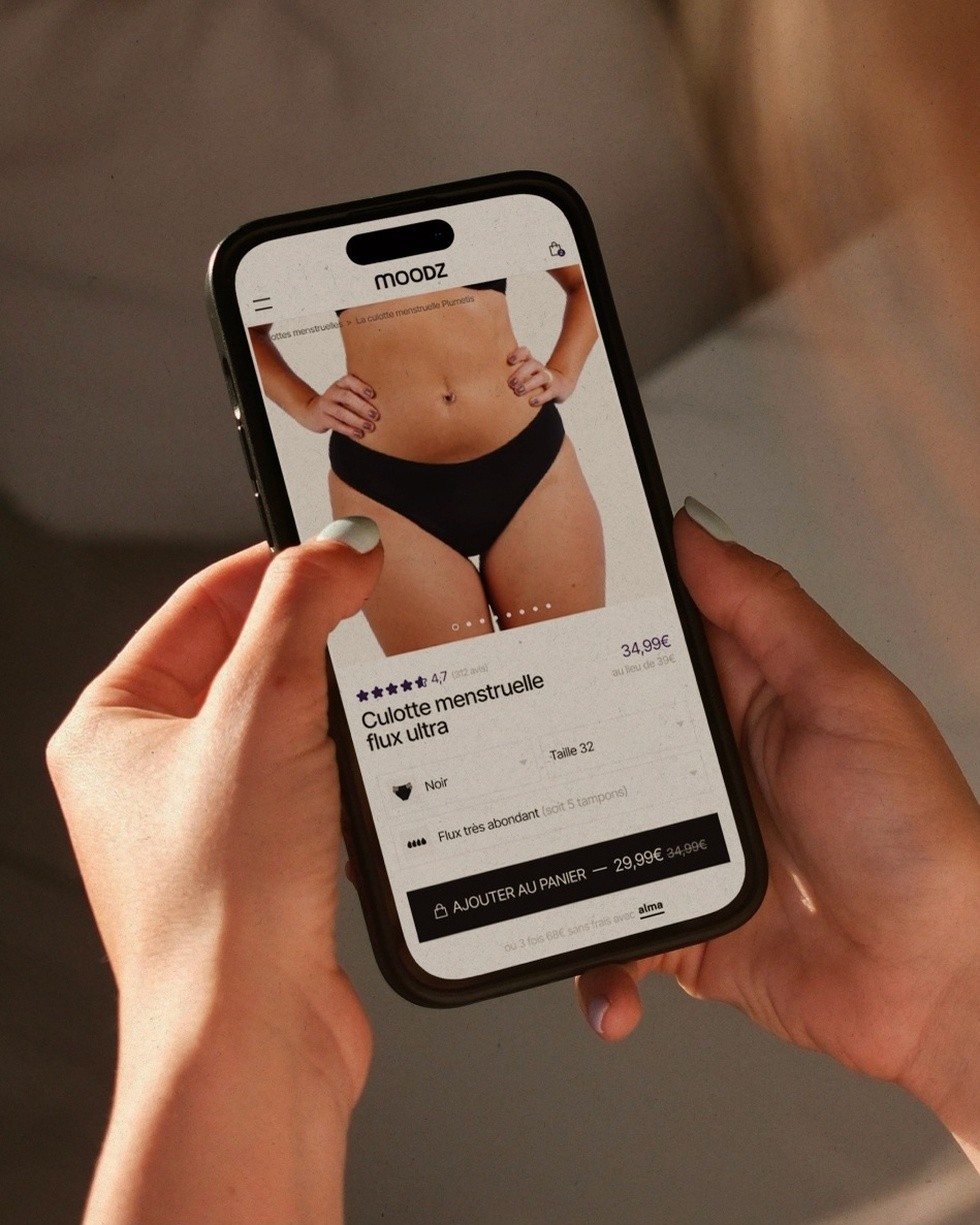
Moodz: product pages and bundles reworked, +45% conversion.

2 to 4 months
Full store redesign
The theme no longer looks like the brand and the journey has been patched up collection after collection. Funnel, templates, brand pages, a storefront developed by Dafolle.
Funnel, product pages, collections, homepage
Shopify or Framer Commerce storefront
Emails, tracking, training
Pômesse in two months, Invoxia in seven months with testing.
4 to 6 months
Brand and store
You're changing your range, your target or your name. Identity first, packaging along the way, the store after.
Identity and packaging
Full store
Product visuals and launch campaign
Alpagga, Mokaco, Nasdrow.
One model for all three: a monthly subscription, tasks weighed before kickoff, and testing included after launch. Prices are on the pricing page.
A handcrafted e-commerce website redesign, for product pages AI recommends
Shopify Magic, generated themes and one-click product descriptions give every store the same family look. Meanwhile, shoppers ask ChatGPT which product to pick before they even search for your brand. A store that looks like all the others doesn't get recommended.
Art direction and packaging, handcrafted
What people remember about a brand that sells products is a world: colors, photos, tone, box. It gets designed, not generated. The store's design system follows from it.
Product pages structured for answer engines
Structured product data, price, availability, reviews, Q&A. What the shopper reads, the shopping assistant understands too, and it cites the stores it understands.
On-brand visuals, generated when a shoot isn't possible
A documented photo art direction, then visuals generated with Midjourney in a repeatable style, for variations and campaigns. Nasdrow launched its brand with it.
A store generated without direction looks like a free theme. A store designed by hand, then extended with AI, keeps its world with every collection.

Product page
When we launched Dafolle, we had had enough of website redesigns that drag on for eight months, cost six months' worth of contract amendments, and end up with a site that no one dares touch anymore.
We built a model for the exact opposite: a subscription with no quotes, senior designers recruited for their business acumen, and an AI infrastructure that we enhance every month so your teams remain autonomous after we're done.
If you're hesitating about entrusting your redesign to us, let's take fifteen minutes. I'll tell you what we can do, and what we won't do.


Joffrey & Clara
Co-founders of Dafolle


The tools we use for an e-commerce website redesign






What if your e-commerce site has a different need?

How much does an e-commerce redesign cost at Dafolle?
You pay for it in months of subscription. Plan on about one month to optimize the checkout and your best-sellers' product pages, two to four months to redesign the whole store with development. Plans start at €4,200 excl. VAT per month, development is included from the Grow plan, and every task shows its credit weight before it starts. Details are on the pricing page.
How long does an online store redesign take?
Two to four months for a full redesign: three weeks on checkout, two weeks on product templates, two weeks on brand pages, then four to six weeks of development and testing. Pômesse went from first deliverable to launch in two months. The number of products and apps to reconnect affects the timeline.
Framer Commerce or a custom Shopify theme?
Framer Commerce when the brand needs creative freedom and your team wants to edit the storefront in two minutes: the storefront lives in Framer, the catalog and payments stay in Shopify. A custom Shopify theme when your store relies on apps deeply tied to the theme, or has a very large catalog. Either way, Dafolle builds it.
You're a Shopify Partner. What does that change?
It means we know the platform inside out: checkout, apps, themes, limits. We keep Shopify Checkout for payments, set up the apps that matter (reviews, follow-ups, shipping), and you stay the owner of the store and every login.
Do you migrate from WooCommerce, PrestaShop or Wix?
Yes: catalog, customers, orders, content, redirects and product page SEO. For a large catalog, the migration is automated and tested on a sample before the cutover. Your product pages keep their search rankings.
Who writes the product pages?
We write the structure of each page around purchase objections, and fill it with your material: customer reviews, customer service verbatims, specs. If you don't have time, we draft a first version for you to approve.
What about product photos?
Your photos, if you have them and they hold up. If not, a documented photo art direction and visuals generated with Midjourney in a repeatable style, like we did for Nasdrow. A shoot is still an option: we direct it, we don't shoot it.
How do you measure that the store sells better?
The metrics are set in the Metabrief: conversion rate, drop-off by step, average order value, mobile share. We compare before and after, then test one hypothesis at a time on your traffic. At Moodz, redesigning the product pages and bundles drove +45% conversion.
Will I be able to manage my store myself?
Yes. You manage the catalog in Shopify as before, and you edit the storefront in Framer or the theme editor in two clicks. A one-hour training, a documented design system, and your team publishes the next collection without us.
Do you also handle emails and follow-ups?
We design the templates to your brand guidelines and set up the abandoned cart, confirmation and follow-up flows in Klaviyo or Brevo. Long-term email strategy stays with you or your CRM provider.